
Hands-on stuff in every room, winding staircases and costumed Victorians make Clayton Hall a fun place to explore for the whole family.
The Grade II*, 15th Century Hall is a rare example of a moated manor house. There has been a house on the site of Clayton Hall since the 12th century and the mound on which the Hall is built is a scheduled ancient monument — a protected and nationally important archaeological site.
Originally built for the Clayton family, Clayton Hall has seen many different owners including the Byrons and the Chethams, with Humphrey Chetham being one of Clayton Hall’s most notable owners. The existing building has Georgian and Tudor sections which are from the remaining western wing of a once larger house, thought to be demolished in the 18th century.
We have six Victorian rooms, with dressing up costumes and hands-on activities, for visitors of all ages to experience what life was like in the late 1800s. Our Memories Room houses our local history collection, whilst our Textiles Room has a selection of vintage sewing machines and some lovely examples of needlework and Christening gowns.
Visitors are welcome to join our history talks to learn about the Hall and her occupants including a tribute to the life and work of her most famous owner, Humphrey Chetham.
Whilst you’re here, why not visit our tearoom and try our delicious homemade soup and cakes?
Our friendly, enthusiastic volunteers are waiting to introduce you to the Hall, who we lovingly refer to as ‘Our Old Lady’, and to welcome you to an unexpected little oasis in a busy part of Manchester. Come along and make yourself at home!
Watch: Clayton Hall’s Secrets
Mysterious marks at Clayton Hall…
Witch marks — or apotropaic marks — have very little to do with witches or witchcraft. Created by the people who built Clayton Hall over 500 years ago, these markings are believed to have turned away evil, providing protection to the building and those who lived or worked within it. There are dozens of these at Clayton Hall — how many can you find?
Clayton Hall’s lost barns
Clayton was once the beating heart of industrial Manchester. Everywhere you look you can see traces of it to this day — but it wasn’t always like this.
Discover Clayton Hall’s links to Clayton’s agricultural past.
Clayton Hall and the Tudor Home: The Chimney
What did the Tudors do for us?
We take a look at Clayton Hall’s chimneys and look at how this Tudor invention revolutionised the home.
The Story of How the Museum Began
Formed in 2004 by local residents keen to support Manchester City Council in improving Clayton Park, the Friends of Clayton Park began volunteering in the park and hosting a range of annual community events. We raised funds and successfully applied for grants to support improvements, including the purchase of new play equipment, replacement of railings, installation of benches and litter bins, and acquisition of essential tools such as gardening and litter-picking equipment. We also bought marquees, tables, chairs, gazebos, catering equipment, and other resources for events and activities.
We redecorated and made use of a room in Clayton Hall for meetings and Christmas events, using the dining room for Father Christmas visits. At that time, the Hall was in a state of disrepair and largely used to store unwanted items.
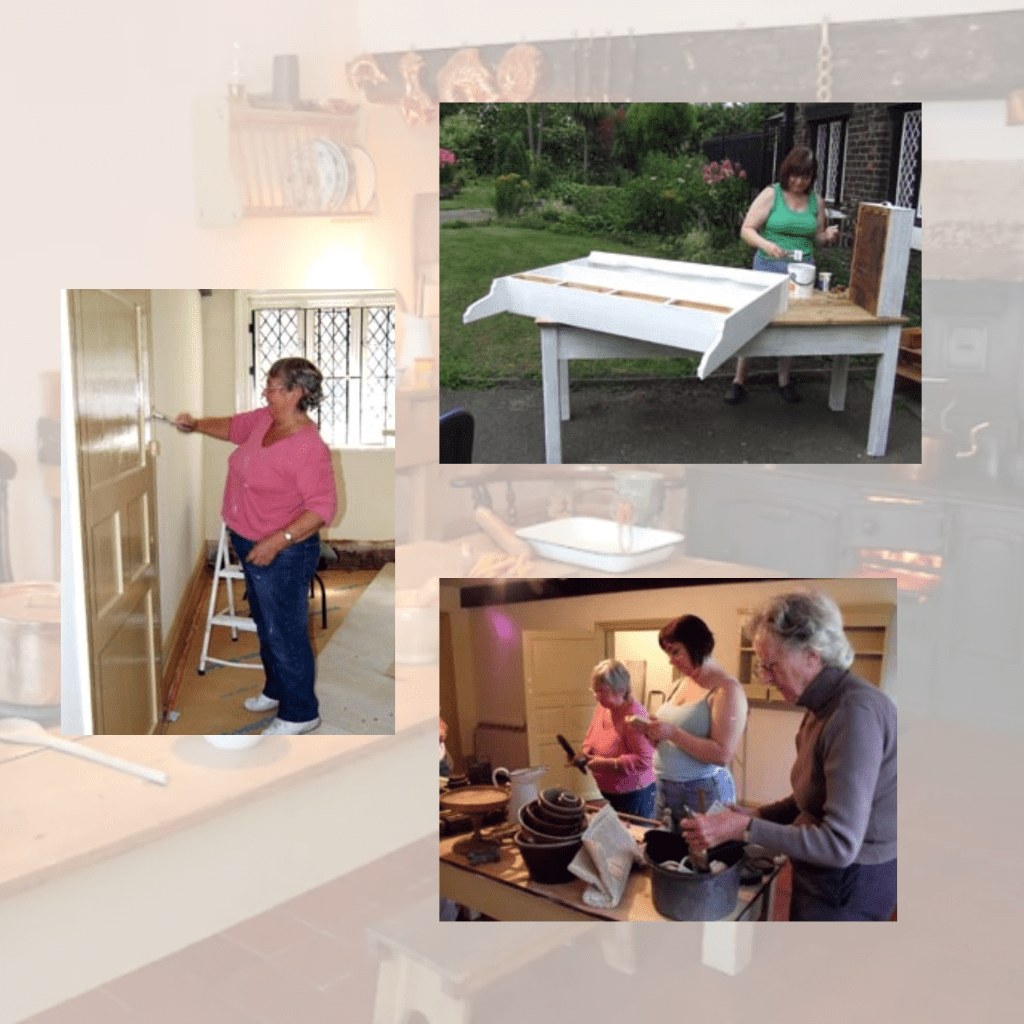
Five founding members—Alma, Kay, Lynn, Pauline, and Shirley—were determined to preserve and improve the Hall and open it to the public. They sought and received permission to establish a hands-on living history museum. Work began in earnest to prepare the Hall for public access in 2009. They were supported by Kay’s youngest daughters, Rachel and Sarah.
With a grant of £6,400, they decorated and furnished four rooms in the style of a late Victorian home, completing the work themselves in order to remain within budget. This included painting and decorating, joinery, furniture restoration, bricklaying, plastering, researching and sourcing authentic artefacts.
The first three rooms—the kitchen, dining room, and cold store room—opened to the public on 28th November 2009. The wash house, which could not be completed in time for the initial opening, was launched in Spring 2010. A Memories Room was also created, where visitors could browse local history information and memorabilia.

Over time, additional rooms were added: a Victorian bedroom, drawing room, and a textiles room featuring artefacts related to textiles and fashion, along with a large collection of dressing-up costumes.
In 2014, the museum achieved charitable status. The five co-founders became the first trustees, joined by invited members of the board. Sir Warren Smith KCVO JP, former Lord-Lieutenant of Greater Manchester, became the charity’s patron.
In December 2016, the Friends and trustees closed the museum temporarily to work in partnership with Manchester City Council on preparing the Tudor wing of the building for inclusion in the museum. This major project involved rewiring the entire building, installing a new alarm system and heaters, reinstating a former doorway between the two wings, removing partition walls and built-in cupboards, restoring floors and doors, redecorating most rooms, and installing a tearoom and kitchen servery.
The museum proudly reopened to the public on 3rd June 2017. The Tudor wing now includes the Clayton Hall Room, dedicated to the history of the house, and the Humphrey Chetham Room, commemorating the Hall’s most notable owner.
In 2018, the Friends of Clayton Park were honoured with The Queen’s Award for Voluntary Service. Trustees Dennis and Kay attended the Queen’s Garden Party at Buckingham Palace, and the Friends received the award from the Lord-Lieutenant at a ceremony held at the nearby Gorton Monastery.
Not bad for five local women from East Manchester, is it?

 Clayton Hall Living History Museum